Walk into just about any elementary school classroom today, and you’ll see students using digital devices. And why not? Technology has become intertwined with nearly every aspect of our lives, and when used appropriately, it can be a valuable educational tool. However, as educators, we need to ask ourselves an important question: Are students learning more because of the technology, or are they simply spending more time using it?
Many teachers associate using technology with innovation. “Look at this new website! Isn’t this app great?” But innovation in education doesn’t come from the technology itself. It comes from what students are thinking, creating, investigating, and learning.
Throughout my teaching career, I’ve worked with many teachers who use an app or website simply because “students enjoy it.” And I’ll admit, I’ve been guilty of doing the same thing! Student engagement is certainly important, but enjoyment alone doesn’t guarantee meaningful learning. We need to ask ourselves, “Is this technology supporting the intended learning objective?” When we fail to ask that question, technology can become the focus of the lesson rather than a tool to support it. Students may be engaged with their devices, but the benefits to their actual learning remain unclear.
Using Technology vs. Learning With Technology
So, how can we tell whether technology is genuinely supporting student learning or is simply present in the lesson?
Let’s consider two approaches to a fourth-grade science lesson on electricity.
In the first lesson, students create a slideshow defining important vocabulary related to electric circuits, including the different types of circuits and how they are connected. Students spend a substantial amount of time searching for images, selecting backgrounds, formatting text, and adding visual elements to their presentations.
In the second lesson, students use an interactive website to construct electrical circuits. Their challenge is to connect wires, batteries, switches, and lightbulbs to create a complete circuit that lights the bulb. As they work through the simulation, students predict if their ideas will create a complete circuit to light the bulb, and record their observations on a worksheet, drawing the components of each circuit and identifying whether the circuit is complete or incomplete.
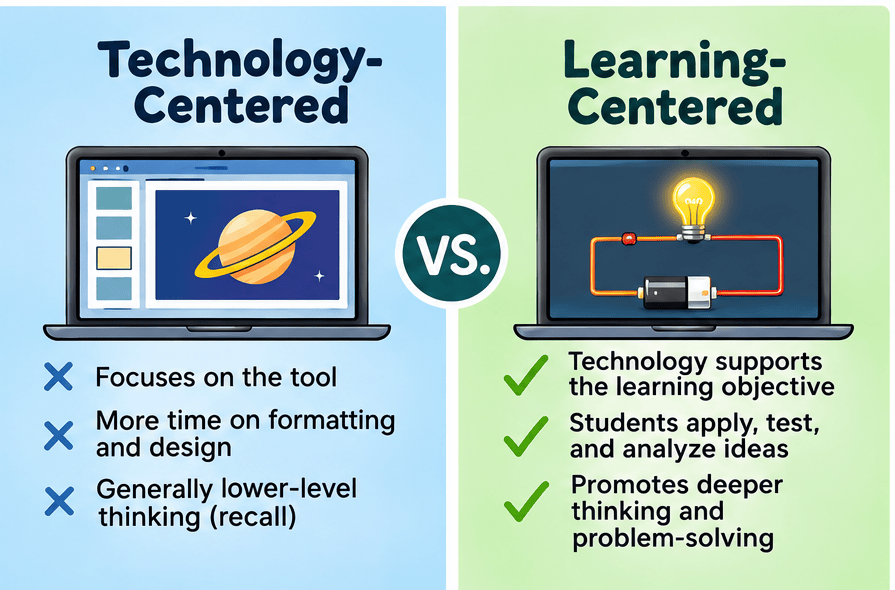
Both lessons involve technology. Both require students to think. However, one is primarily technology-centered, while the other is learning-centered.
What’s the difference?
The answer is simpler than we might think: the learning-centered lesson places greater emphasis on thinking about the actual subject being taught.
In the first lesson, students primarily recall information about electric circuits and present that information using a digital tool. While the activity certainly involves some thinking, much of the instructional time is spent navigating the technology and making formatting decisions rather than developing a deeper understanding of electricity.
The second lesson also requires students to interact with technology, but the focus is different. Students must apply their understanding of electrical circuits, test different configurations, observe the results, and determine why some circuits work while others do not. When students explain their findings, they engage in scientific reasoning, analysis, and problem-solving.
The technology isn’t the purpose of the lesson. It’s the tool that allows students to investigate the science.
Ultimately, the educational value of technology isn’t determined by how exciting an application looks or how much students enjoy using it. It’s determined by what students learn, how deeply they think, and what they can do with that knowledge.
I’d love to say I’ve never fallen into this technology trap myself, but that wouldn’t be true. I remember assigning my sixth-grade Earth science students a digital project about our solar system, thinking it would be an engaging way for them to demonstrate their understanding of the topic. And the students were certainly engaged!
However, as I walked around the classroom, I noticed that many of their conversations focused more on backgrounds, fonts, and animations than on the actual content about our solar system. Even though I had specifically instructed students to focus on the content first and worry about making their projects visually appealing afterward, the technology had become the focus.
Students were spending considerable time creating something that looked impressive, but I began to question how much deeper their understanding of the subject had actually become. Looking back, I realized that while I had given students clear instructions about what to include, I hadn’t done enough to ensure that the science remained at the center of the activity.
Experiences like these have reminded me that just because students are busy and engaged doesn’t necessarily mean they’re learning what I intended to teach.
Start With the Learning Objective, Not the App
Let’s return to our fourth-grade lesson on electricity. We know we want students to be engaged, and we want them to develop a deeper understanding of electrical circuits. But before deciding which resources or activities to use, we need to start with the learning objective. To make sure that learning is at the center, we must start with the learning objective. In this case, the NGSS objective states:
- 4-PS3-2: Make observations to provide evidence that energy can be transferred from place to place by sound, light, heat, and electric currents.
So, in order to successfully achieve this learning objective, students don’t need to only be able to recall the parts of a complete circuit; they need to be able to explain how energy is transferred along the circuit, then model circuits on their own. This can be done in a variety of ways, both hands-on and digitally – I am not advocating that digital simulations should take the place of hands-on learning. Using technology can be very helpful, though, especially when working with large class sizes and limited materials. For example, a group of students can work with hands-on materials, and another group can reinforce the learning objectives using technology.
Technology can be very engaging, but we need to be careful that the use of technology in a lesson isn’t only engaging. There are many activities that teachers can choose using technology that are very engaging, but do not enhance student learning. There are countless educational games that students love to play. They have fun sounds, colorful animations, and some type of scoring system that keeps students coming back for more. And these games certainly have their place, particularly when students need to practice or reinforce previously learned skills. However, we need to be careful not to confuse practicing a skill with developing a deeper understanding of a concept. Both are important, but they serve different instructional purposes.
As educators, we need to ask ourselves: What exactly are students learning or practicing when they play these games, and does that align with what we’re trying to teach?
When Technology Should Be the Lesson
There are certainly times when technology itself should be the focus of instruction. Teaching students how to navigate digital environments, develop coding skills, and use productivity tools is an essential part of preparing them for the future. Having held multiple positions throughout my career, I can attest that students do need to learn how to navigate the internet safely, develop coding and keyboarding skills, create slideshows and spreadsheets, edit documents, and use digital tools responsibly. These skills are increasingly important in our society and will serve students throughout their lives. These are the skills that are outlined in the ISTE Standards for Students that are the basis of my lessons as a Technology teacher. As a classroom teacher, I frequently incorporated these skills, as well, listing them as one of my supporting objectives. As in the previous example, if I need my students to fully understand electric circuits, I may need to introduce and teach them how to use an element of technology to support their learning, and that’s ok. Students can learn how to use the technology while keeping their primary focus on understanding the science.
After more than twenty years in education, one thing I’ve learned is that good teaching doesn’t begin with a textbook, an activity, or the latest technology. It begins with understanding what we want our students to learn and finding the best way to help them get there.
As educators, we’re constantly encouraged to try new things, incorporate new technologies, and find creative ways to engage our students. I’ve certainly been guilty of trying to do it all! But sometimes, the most innovative decision we can make is to simplify our approach and focus on what matters most.
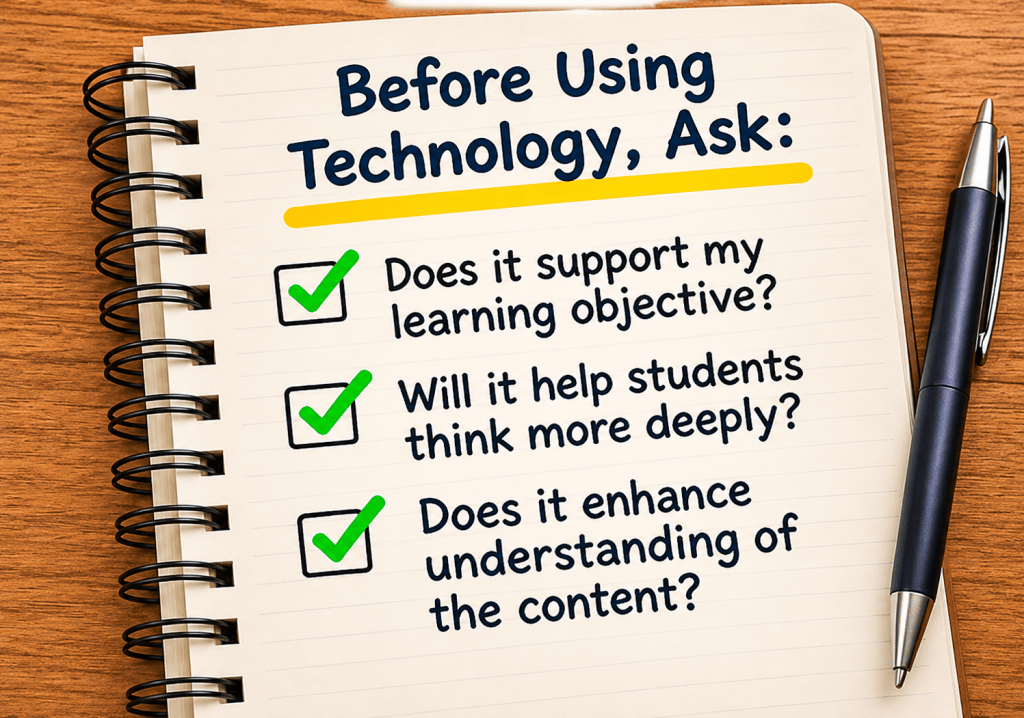
Before introducing technology into a lesson, ask yourself one simple question: Will this help my students better understand what I’m trying to teach?
If the answer is yes, use it. If the answer is no, perhaps there’s a better approach.
Technology is a tool. Learning is the goal. Let’s make sure we never confuse the two.


Leave a Reply