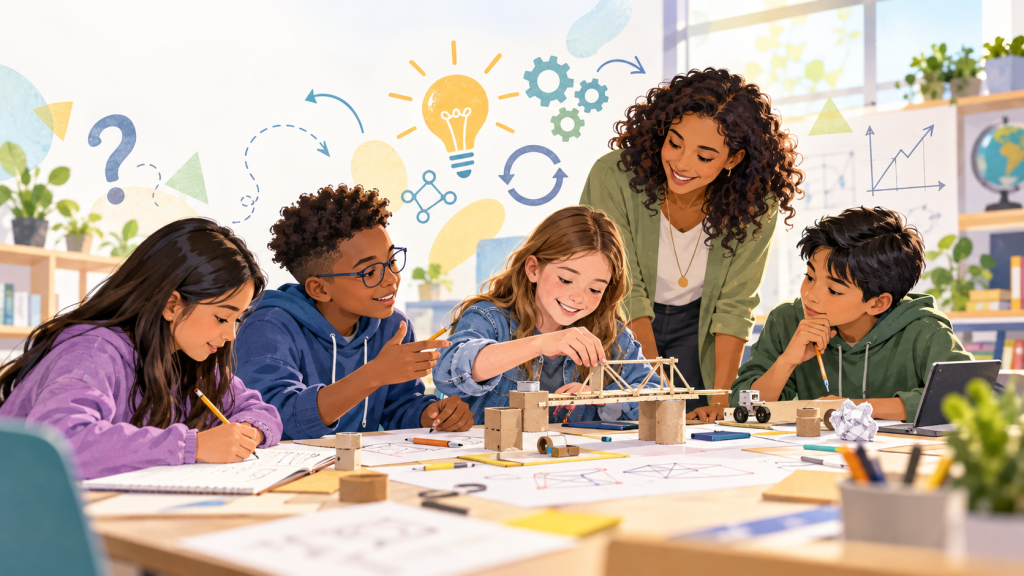
What is STEM Education? I know that many people have been defining this term for many years…and with many different definitions. I have been studying STEM Education for years, trying to come up with my own answer. Here is what I have found out:
STEM is NOT about the materials or the activities. It’s about the THINKING. On the surface, STEM is defined as the intersection of 4 subjects: Science, Technology, Engineering, and Math. However, STEM learning does not have to live within those four subjects. Educators frequently integrate STEM with art, reading/ELA, social studies, religion, and other areas of the curriculum.
STEM has also been associated with activities that encourage students to engineer objects, design and build structures, and participate in hands-on learning. Sometimes STEM means coding and robotics. Other times, it means tinkering in a makerspace.
And a common thread running through many of these approaches is projects. Project-based learning is often associated with STEM—and it can be a powerful approach across the entire elementary curriculum.
So, that raises the question: How can one teacher possibly tie all of these definitions together in order to create meaningful, engaging STEM lessons?
Simple.
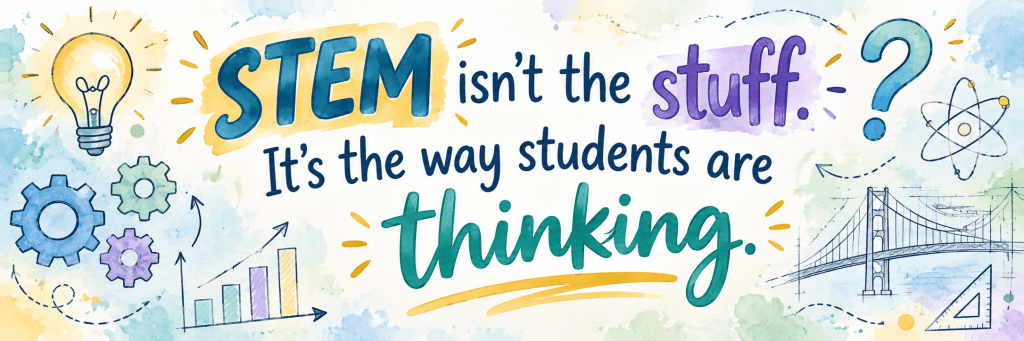
STEM isn’t the stuff. It’s the way students are thinking.
- STEM is not automatically using robots.
- STEM is not automatically building with LEGO.
- STEM is not automatically doing a science experiment.
- STEM is not automatically using technology.
- STEM is not automatically completing a “STEM challenge.”
Any of those can become powerful STEM learning — but only if students are being asked to think, solve, design, test, revise, and make decisions.
So, we know STEM is getting kids to think, but what does that look like? Is it just combining all of these ideas into one mega-lesson?
Who has time for that?
Definitely not.
Thinking, deep thinking, looks like the following:
- Asking questions
- These questions don’t have to have an answer. They don’t even need to be science-related. Students who wonder are students who think.
- Identifying problems
- What in our world can be improved? What is something people need? Is there a way to help anyone in need? Thinking students look for problems that need solving.
- Looking for patterns
- How is this problem similar to what already exists? Is there a way to automate a solution to the problem? Patterns exist in nature, technology, mathematics, and our everyday lives. Students think when they recognize those patterns and apply them in new ways.
- Breaking problems into parts
- As adults, we do this all the time. A huge task can feel overwhelming. Break it into smaller pieces, and suddenly it becomes manageable. Students need opportunities to examine complex problems, identify their parts, and decide how to tackle them.
- Designing possible solutions
- Sometimes our first idea is our best—but rarely! Students should be encouraged to consider many solutions, including the far-fetched and crazy ones, before deciding which ideas are worth pursuing.
- Testing, revising, and trying again
- Good solutions take time. Designs rarely work perfectly on the first attempt. Students should test what they create, think about what worked and what didn’t, revise their ideas, and try again. That cycle is where some of the deepest STEM thinking occurs.
- Explaining the reasoning behind a decision
- Students should be able to explain the why behind what they did. When students can defend a decision, explain a design choice, or describe why they changed their approach, we get a window into their thinking.
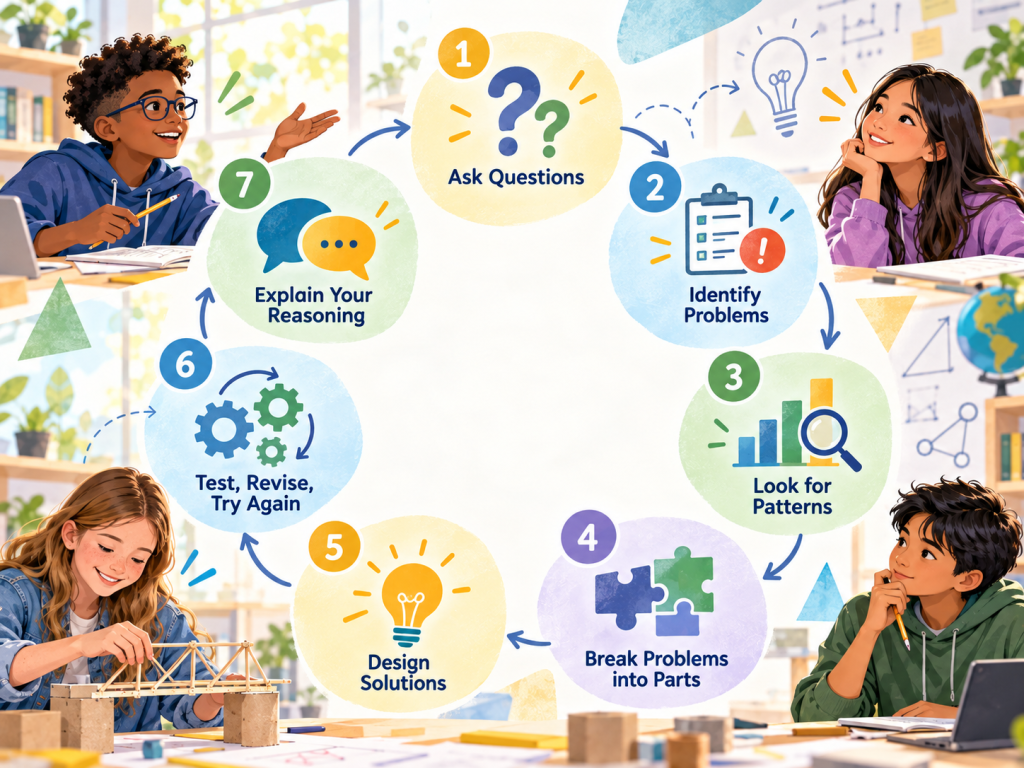
All of these kinds of thinking can be woven into one project, built around one meaningful goal, while addressing a core set of standards.
And that’s the point.
When teachers start with the standards and learning goals, then design a project that helps students meet them, the focus shifts away from simply doing a STEM activity and toward designing an experience that makes students think.
That is also the purpose of this site.
After more than 20 years of teaching, I want to share what I have learned about STEM education—the successes, the challenges, the projects, and the ideas that have changed my own thinking. My goal is to support teachers like me: educators who value meaningful, hands-on learning experiences that spark student thinking and creativity.


Leave a Reply